What happens during a mold inspection is easier to follow once you separate the visit from the lab. A professional looks at the building and asks what changed. Moisture readings and thermal imaging then help find damp materials. That visit is not the same as collecting samples for a laboratory. iMold’s no-cost visual mold inspection is built around that first look. You leave with a clear next step instead of a guess.
Call (877) 771-1699 for a no-cost visual mold inspection
The sections below walk through one visit in order. They cover the opening questions, the visual check, how readings and thermal images are used, and how those findings differ from third-party testing. For the signs that prompt a call, see when Southwest Florida homeowners should schedule a mold inspection. For price questions, see what a mold inspection costs in Southwest Florida.
What happens during a mold inspection, from the first question to the last note
The visit starts before anyone opens a meter. The technician asks what you noticed, when it started, and what has already been repaired. A recent leak, a musty closet, or a stain that returned after paint all change where the check begins. You do not need a diagnosis. A short history is enough.
Useful details include the property’s age, prior water events, rooms that smell strongest, and any HVAC or plumbing work. If a tenant, buyer, or insurer raised the concern, say so. That context keeps the visit focused on the question you actually need answered.
Access matters as much as the story. The technician needs a clear path to the area of concern, plus nearby bathrooms, the air handler, and any attic or crawl space that can be reached safely. Pets and stored items in the way slow the check. You do not need to empty the house.
From there, the visit usually follows the same order:
- Review the history and the room or area that prompted the call.
- Look at accessible surfaces for staining, odor, and visible growth.
- Take moisture readings on materials that look dry but may not be.
- Use thermal imaging to see temperature patterns that can point to hidden moisture.
- Explain what was found, what was not checked, and what the next step is.
Nothing in that order requires a hole in the wall. iMold’s visual inspection is a non-invasive, surface-level evaluation. If a reading suggests moisture behind a finish, the note records that limit. Opening the wall is a later decision, not the default end of the visit.
The EPA’s Brief Guide to Mold, Moisture, and Your Home puts the same idea simply: the key to mold control is moisture control. An inspection that never looks for the water source has not finished the job, even if a stain is obvious.
What the visual check covers, and what it does not
The visual portion is a careful look at accessible surfaces and the conditions around them. The technician is looking for discoloration, water stains, peeling paint, warped trim, and musty odor. Those clues are recorded with the room and the material, not treated as a final label.
High-risk zones get extra attention in a Florida home. Bathrooms, kitchens, attics, and HVAC closets collect humidity and small leaks. Around Fort Myers, Cape Coral, and Naples, a slow air-conditioner drain or a roof leak after a storm can wet drywall long before a spot is easy to see. The check follows the clue, then the nearby assemblies that share that moisture path.
A visual check can confirm growth you can already see. It can also show that a stain is dry, localized, and not tied to an active source. It cannot prove that every hidden cavity is clear. No surface look can do that. The written note should say which areas were reached and which were blocked by finishes, stored items, or unsafe access.
iMold does not collect samples during this free visual inspection. That is a feature of the visit, not a missing step. If you need to know whether an area is damp, and where to look next, the visual check plus instrument readings is the right scope. If you need the species in a sample and its concentration, that is a testing question. iMold’s inspection and testing page separates those two services in plain terms.
You should also hear what the visit will not decide. It will not quote a cleanup price before the affected area is understood. It will not tell you a lab result that was never collected. And it will not promise that mold cannot return if the moisture source stays in place.
How moisture readings and thermal imaging fit the visit
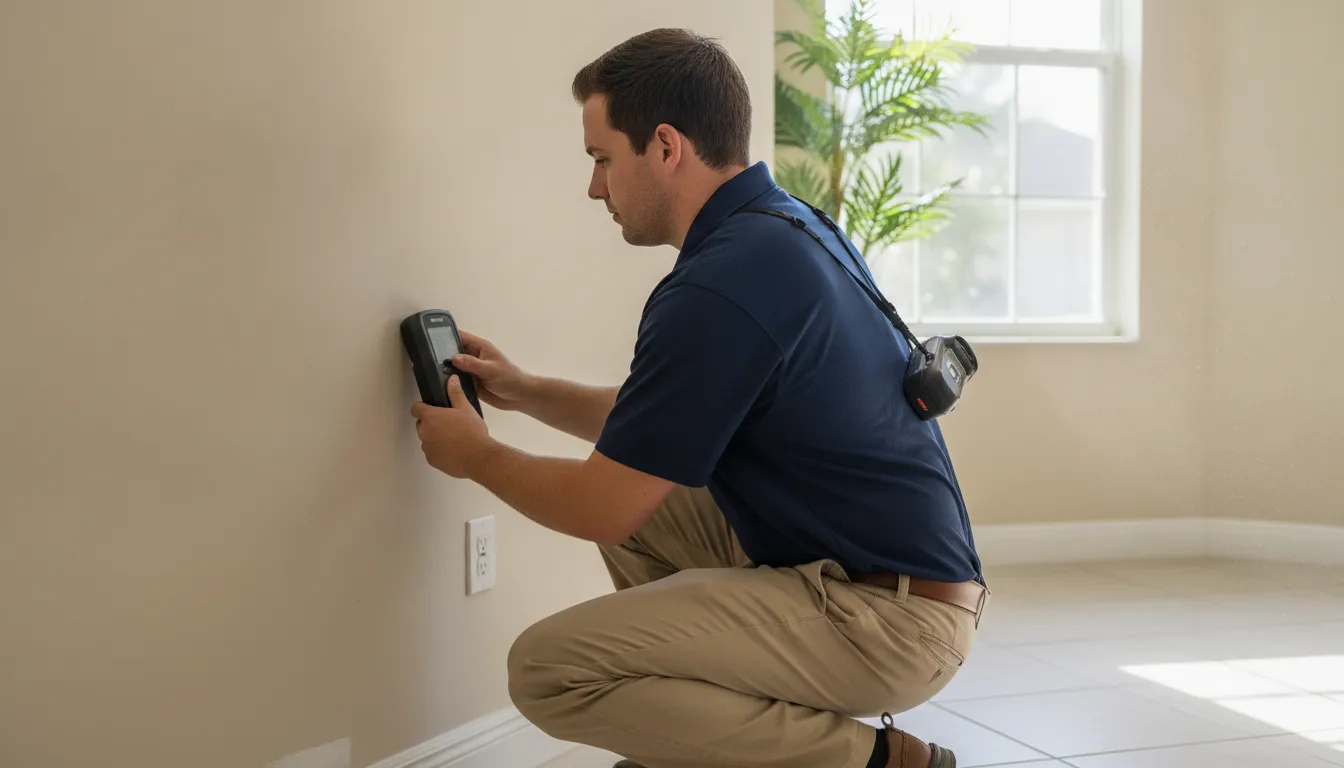

Moisture meters and thermal cameras answer a different question than your eyes. A meter compares how wet a material is against what that material should read when it is dry. A thermal camera shows surface temperature patterns. Cooler shapes on a wall or ceiling can line up with evaporation from hidden water. Neither tool names a mold species.
Technicians use both penetrating and non-penetrating meters. A non-penetrating meter scans drywall, trim, and flooring without a pin mark. A pin meter is used when a specific spot needs a direct reading and a small mark is acceptable. Readings are compared across the suspect area and a nearby dry reference, so one number is not treated as a verdict by itself.
Thermal imaging works best as a map, not a photograph of mold. The camera can show a cool track under a window, along a supply line, or across a ceiling below a bathroom. The technician then confirms that pattern with a moisture reading. A cool spot without elevated moisture can be air flow, insulation, or shade. The two tools correct each other.
On a typical visit, the sequence is short. Scan the area of concern. Mark where readings rise. Photograph the pattern for the notes. Check the likely source, such as a pan, a supply line, a roof penetration, or an exterior wall. Then say whether the moisture appears active or residual. Leak detection is the right follow-up when the source is still releasing water.
Florida humidity is the reason these tools matter. A room can smell musty because the air is damp, because a wall cavity is wet, or both. Readings separate those cases. They also keep the scope honest: dry materials do not need to be opened just because a nearby stain looks alarming.
| What you see or hear. | What the tool adds. | What it cannot prove. |
|---|---|---|
| A stain or a musty room. | Whether nearby materials are wet right now. | The mold species, or that hidden areas are clear. |
| A cool pattern on camera. | Where to place the moisture meter next. | That the cool spot is water or mold. |
| An elevated meter reading. | Which materials are damp, and how far that damp area reaches. | How the water got there, until the source is checked. |
| A dry reading after a past leak. | Support for watching the area instead of opening it. | That mold is absent behind the finish. |
How a visual inspection differs from laboratory testing
Testing starts when someone needs laboratory data, not when every inspection ends. A third-party tester collects air or surface samples and sends them to a certified lab. The report can describe the types of mold found in those samples and the concentrations reported for them. iMold does not perform that testing. When it is appropriate, iMold recommends a licensed third party so the result is independent of the company that may later do the cleanup.
The EPA notes that if visible mold is present, sampling is usually unnecessary, because no federal limit sets a “safe” spore count for a building. Surface samples are sometimes used later to check whether a cleaned area is ready to close. That is a different question from the first visit. How to choose residential mold testing services covers provider questions if you are at that decision.
Use testing when a buyer, insurer, or physician has asked for data, or when the source of an odor is still unclear after the moisture check. Skip it when the growth and the water source are already plain and the next need is a cleanup scope. Paying for samples will not dry a wet wall.
Ask these questions before anyone collects a sample:
- What question should this sample answer?
- Who collects it, and who analyzes it?
- Will you get a written report you can share?
- What will the result change about the next step?
If the answers are vague, wait. A sample without a question becomes a number without a decision.
What you should have in hand when the visit ends
A useful inspection ends with notes, not a shrug. You should leave knowing which areas were checked, what the moisture readings suggested, and whether a source was found. Photos of stains and meter locations make that record usable later, especially if an insurer or a contractor needs to see the same spots.
Ask for the limits in writing. If the attic hatch was sealed, the crawl space was unsafe, or furniture blocked a wall, that belongs in the note. A stated limit is more trustworthy than a blanket all-clear.
The same note should separate observation from recommendation. A wet wall beside the air handler is an observation. A recommendation is the suggestion to dry that area and write a cleanup scope.
Three endings are common:
- No active moisture, and no cleanup scope. You may only need a maintenance note and a watch on humidity.
- Moisture or visible growth, with a defined area. The next step is a written remediation quote, not another vague visit.
- A documentation need. A third-party test or a leak-detection visit answers a question the visual check cannot.
iMold can prepare a remediation quote from the visual findings when cleanup is the right path. That quote should name areas, materials, and whether reconstruction is included. The work itself follows iMold’s mold remediation process steps, which start only after this kind of assessment. Do not treat the inspection as the cleanup.
Credentials belong in that handoff too. iMold is an IICRC certified firm, a State Certified Mold Remediator (MRSR2170), and a State Certified General Contractor (CGC1540205). You can confirm the public license wording on the licenses and registrations page. Licensing tells you who is allowed to do the work. It does not replace the moisture notes.
How the findings turn into a quote, a test, or a repair plan
The inspection is the decision point. If materials are wet from an active leak, stopping and drying that source comes before any mold scope. Water damage restoration covers extraction and structural drying when the loss is still a water problem. Mold remediation is the path when growth and affected materials need removal or cleaning under containment.
A quote built from the visit should be specific. It should say which rooms, which materials, and whether contents cleaning or rebuild work is included. Containment, air control, and a clearance plan belong in that scope when the affected area calls for them. The IICRC S520 standard is the mold remediation reference professionals use to organize that kind of work. You do not need to memorize the standard. You do need a scope that says what will be done in your building.
Insurance paperwork is easier when the notes exist on day one. iMold documents affected areas with photos and moisture readings and can work directly with your carrier, including estimates prepared in Xactimate. Insurance claims support explains that coordination. Coverage still depends on your policy. An inspection does not guarantee payment.
If the finding is a small, dry stain and the meter agrees the material is dry, the honest plan may be to monitor it. If the finding is an ongoing leak into a wall, the honest plan is to stop the water, dry the assembly, and then decide what finishes must be removed. Either answer is better than a test kit taken in a closed room with no moisture map.
Homeowners who want the broader service picture can review mold removal services and how an iMold project moves from assessment to restoration. Those pages cover the work after the visit. This one stays on the visit itself.
Schedule a no-cost visual inspection
Frequently Asked Questions
How long does a mold inspection take?
Many home visits take about one to two hours. A larger house, several wet areas, or limited access can take longer. The time is spent on history, accessible areas, readings, and notes, not on a single pass through the front door.
Will the inspector always find mold?
No. A careful visit often finds a dry stain, a humidity issue, or no accessible growth at all. The goal is an accurate account of the areas checked, not a guarantee that mold is present.
Do I need to leave the house during the inspection?
Usually you can stay. The visual inspection does not use containment or demolition. If a later remediation scope says an area must be contained, that instruction comes with the quote, not during this visit.
Should I wipe or paint the spot before the appointment?
Leave it. Cleaning, painting, or running a fogger can hide the clue the technician needs. You may move light furniture if it blocks a wall, and you should mention any leak that is still active.
Does a clear visual inspection mean there is no mold in the walls?
It means the accessible areas that were checked did not show a reason to open finishes. It cannot certify every cavity. If a meter or thermal pattern suggests hidden moisture, the note should say so and name the next step.
Ask for a clear record of the visit
Start with the visual visit if you want to know what is damp. It also shows what was only a stain, and whether testing or cleanup comes next. iMold offers that inspection and the estimate at no cost, 24 hours a day, across Southwest Florida. Call (877) 771-1699 or send a note through the contact page. You will get a licensed, insured team and a written next step, not a scare tactic.