

Commercial mold remediation is the documented cleanup of mold and the moisture that fed it in a business, office, restaurant, retail space, or other occupied building. A musty office after a weekend leak, stained ceiling tile over a sales floor, or a closed room that still smells damp are manager decisions, not housekeeping chores. The useful question is simpler. Can the affected area stay in normal use, or does it need containment, a written scope, and work planned around occupants? iMold provides 24/7 emergency service across Southwest Florida. Commercial mold concerns start with a no-cost visual mold inspection and estimate.
Call (877) 771-1699 for 24/7 commercial mold help
When does a business need commercial mold remediation?
Call for commercial mold remediation when visible growth returns after wiping, a musty odor stays after the water is gone, or moisture is still in drywall, ceiling tile, cabinetry, or flooring. A one-time spill that was dried the same day is a different job from a leak that sat through a weekend in Florida humidity. The U.S. Environmental Protection Agency’s checklist for mold remediation in schools and commercial buildings says to dry wet, non-moldy materials within 48 hours. The same checklist says the plan has to fix the moisture source. Otherwise the growth can return after the surfaces look clean.
Use these signals to separate a maintenance cleanup from a remediation scope:
- Growth covers more than a small patch, or it is on porous materials such as drywall, ceiling tile, insulation, or carpet.
- The room was wet for more than 48 hours, or the source, such as a roof, pipe, or air-conditioning drain, is still active.
- Occupants report a persistent musty odor, or the stain is on the occupied side of a wall while the back of the material is unknown.
- The space is a workplace, restaurant, retail floor, hotel room block, or other area that cannot be casually closed without a plan.
- You need documentation for an owner, insurer, or property manager before anyone removes building materials.
A homeowner guide about when to call for professional mold remediation covers houses. A business adds occupants, operating hours, and shared HVAC. A stained carpet in a suite is a contents question, covered in carpet mold remediation, not the whole building plan. If the building was flooded by a storm, start with drying and documentation the way you would after any mold concern after water intrusion, then decide whether remediation is the next step.
What should a manager limit before the crew arrives?
Do not wipe, scrape, or spray the growth, and do not run fans across it. Disturbing a colony can move debris into the rest of the suite. Keep people and pets out of the affected room, and avoid storing clean goods, open food, or linens there. If a ceiling tile is collapsing or water is still dripping, control the leak if you can do it safely, then leave the wet materials in place for documentation.
Write down what you know before anyone arrives:
- When the leak, humidity spike, or odor was first noticed, and whether the space stayed wet overnight.
- Which rooms, floors, or tenant areas are involved, and whether the HVAC serves those rooms and neighboring suites.
- Who must stay open: a sales floor, kitchen line, clinic corridor, or front desk.
- Photos of the stain, the ceiling, and any wet contents, taken without pulling materials apart.
That note is the start of the assessment, not a diagnosis. iMold’s no-cost visual mold inspection looks at visible conditions with moisture meters and thermal imaging and recommends a next step. It does not collect lab samples. When testing would help, iMold recommends an independent third party so the result is separate from the company doing the cleanup.
How is commercial work different from a home job?
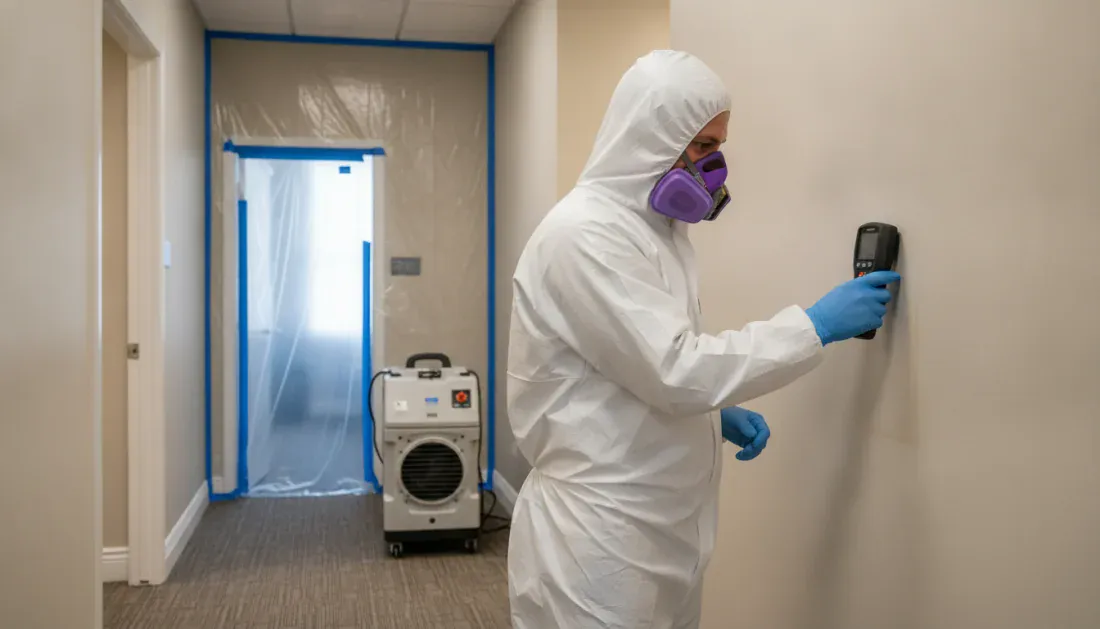
The cleanup steps can look similar. The operating constraints do not. A house can often be emptied for a few days. A store, office, or restaurant usually cannot. Commercial mold remediation has to say which rooms close, which stay open, and how dust and debris stay out of the open side.
| Decision. | Typical home job. | Commercial mold remediation. |
|---|---|---|
| Who is in the building. | One household, often able to leave. | Employees, customers, or guests may need part of the building to stay open. |
| Work hours. | Daytime access is usually fine. | Phases may follow closing time, a slow day, or a vacant wing. |
| Shared systems. | One air handler for the house. | Shared HVAC, ceiling plenums, and corridors can connect suites. |
| Documentation. | The owner and sometimes one insurer. | Owner, manager, tenant, and insurer may each need the same written scope. |
| Contents. | Personal belongings. | Inventory, files, food, or equipment that should not be bagged casually. |
iMold schedules commercial remediation around business hours when the building can support that, and the team is IICRC certified. The commercial mold removal service page is the place to request that work. This guide stays on the manager’s decisions before and during the visit. For the ordered cleanup itself, the mold remediation process steps already explain the iMold sequence, so this article does not repeat it.
Which buildings change the plan
Not every commercial address needs the same boundary. Match the first question to how the building operates:
- Offices can usually move a team to another suite. The risk is a shared return-air path above the ceiling.
- Retail needs the contained room off the customer path, including a stockroom that opens onto the sales floor.
- Restaurants should keep demolition and debris away from prep tables, even if the stain is only in dry storage.
- Hotels and apartment buildings need a floor plan so one room does not become a corridor problem.
- Schools, clinics, and government buildings should name one occupant contact before plastic goes up.
iMold’s commercial work covers offices, retail, restaurants, hotels, manufacturing spaces, and churches. Service runs through Lee, Collier, Charlotte, Sarasota, and Manatee counties. The no-cost visual inspection is the same starting point. The phasing is not.
How should occupied offices, stores, and restaurants be phased?
Phase the building instead of treating every room as one shutdown. Close the affected room first. If growth is in a ceiling used as a return-air path, isolate that space so debris does not travel next door. Keep restaurant work away from open food. Keep a contained retail room off the sales path. An office can often move one team for a day instead of closing the address.
Ask for three zones on a simple floor sketch: the work room, a buffer such as a hallway, and the area that stays in normal use. If staff prop open the door between those zones, the phase is not real yet. Agree on who may cross the line, and during which hours.
The EPA describes two containment levels. The choice is about exposure, not about picking the smallest setup:
- Limited containment is generally used for about 10 to 100 square feet. A single layer of fire-retardant plastic, a covered entry, sealed vents, and negative pressure with a HEPA-filtered fan are the usual controls.
- Full containment is recommended above about 100 square feet, or any time the occupied space would be contaminated without it. That setup uses two layers of plastic and an airlock entry.
A heavy colony in a small closet can still justify the tighter setup. Do not use the square-foot ranges as a promise of what your building will need. Ask the written plan to name the rooms, the containment level, and whether work happens after closing. If people must remain elsewhere in the building, read how crews plan occupancy during remediation and apply the same question to employees and customers.
What should the written scope explain?
A clear commercial scope is a work boundary, not a slogan. Before you compare proposals, ask for these items in writing:
- The rooms and materials included, and the moisture source the plan will correct or hand to another trade.
- Containment, negative air, and how open areas, kitchens, or sales floors stay separated.
- Which porous materials are expected to be removed, and which hard surfaces can be cleaned.
- Whether independent testing is recommended, and that it is separate from the remediation crew.
- How contents, inventory, and equipment will be protected or cleaned.
- The hours of work and which parts of the business can stay open.
- What reconstruction is included now, and what is a later repair.
Price is a custom quote after that scope, not a rate card. iMold does not publish a dollar figure for commercial mold remediation. Materials, access, and hours change the job. Hearth financing, including 0% options, can be discussed for payment. It is not a reason to skip the scope.
Insurance may pay some of the work when a covered event caused the moisture. Coverage is not automatic. The payer questions for a house, rental, condo, or business are already answered in who pays for mold remediation. Use that guide for the claim. Use this one to decide how the building operates while the work is scoped.
When are testing and reconstruction separate steps?
Visible growth does not always need a lab sample before cleanup. The EPA notes that sampling is often unnecessary when growth is visible. Sampling is more useful in three cases. The source is unclear. Health worries are part of the conversation. Or a dispute needs an outside record. iMold uses third-party testing when it adds information. It is not a hurdle on every call.
Reconstruction waits until the moisture source is addressed and the cleanup scope is done. Replacing drywall on a wet wall only hides the next colony. If the building also has an active water loss, water damage restoration support may have to finish drying before mold work, or run beside it when the source is still wet. Air handlers and ducts are their own decision: do not assume a room cleanup covers the HVAC. Read about mold that may be in the HVAC when the odor comes from supply vents.
iMold is a State Certified Mold Remediator (MRSR2170) and a State Certified General Contractor (CGC1540205). Technicians are IICRC certified, so cleanup and later repairs can be coordinated without treating them as the same visit. The company has served Southwest Florida for 28 years. A no-cost visual inspection is the start. An assessment does not guarantee a health outcome, and it does not mean every material can be saved.
Call (877) 771-1699 to schedule a no-cost visual inspection
Frequently asked questions
How much does commercial mold remediation cost?
There is no flat price. The quote follows the rooms involved, how long materials stayed wet, the containment the occupied building needs, and whether repairs are in the same scope. Ask for that scope in writing, then compare estimates against it. iMold starts with a no-cost visual mold inspection and estimate.
Can employees stay in the building during the work?
Often yes, in the unaffected areas, if containment is holding and the plan names which rooms stay open. Kitchens, clinics, and sales floors need a tighter boundary than an empty storage room. If negative air or a closed corridor cannot separate people from the work, that part of the business should pause.
What do crews use on a commercial job?
Expect moisture meters, containment plastic, negative air with HEPA filtration, and removal of porous materials that cannot be cleaned. Hard surfaces may be cleaned rather than demolished. The exact tools belong in the written plan, matched to the materials in your building.
Does a small patch in an office still need a professional?
A tiny spot on a hard surface, dried the same day, may be a maintenance cleanup. A patch on drywall, a recurring stain, a musty room, or any growth near a shared air path deserves an assessment. Size alone does not decide it. The material, the moisture source, and the people still using the building do.
Will remediation stop mold from coming back?
Cleanup fails when the leak or humidity remains. A sound commercial mold remediation plan names the moisture source and how it will be corrected. It cannot promise that a future roof leak or a disabled air conditioner will never wet the building again.

