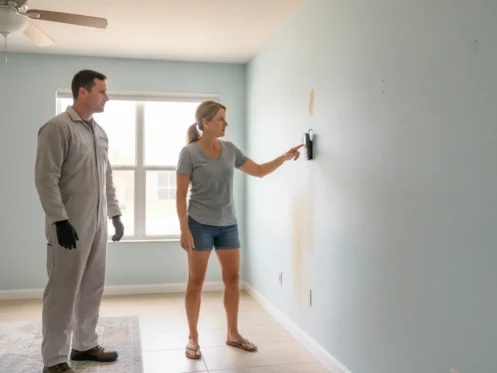
Damage to a home or business can be hard to manage. iMold offers 24/7 emergency service in Southwest Florida. Start with a clear conversation about the next step. Ask a restoration company about its credentials, included work, and progress records.
Get 24/7 emergency restoration help
A restoration company should explain qualifications, findings, included services, and progress documentation before you authorize work.
Ask who is qualified, what the assessment found, which services are included, and how progress will be documented. These answers help you understand the plan.
If there is no active emergency and mold is a concern, iMold offers no-cost visual mold inspections and estimates. A first conversation should clarify the property issue without promising an outcome before an assessment.
Credentials are a practical place to begin: they help you check whether a team is qualified for the specific restoration work your property needs.
What Credentials Should a Restoration Company Have?
Before authorizing work, ask which licenses apply to the proposed services. Ask who holds them and how to verify their current status. A company may handle water mitigation, mold remediation, and reconstruction. Do not assume one credential covers every phase. Ask who will supervise each phase. Find out whether the technicians have relevant training.
For mold or reconstruction in Florida, ask the provider to name its state credentials and share the license numbers. Check them through the state. iMold lists its State Certified General Contractor (CGC1540205) and State Certified Mold Remediator (MRSR2170) credentials. The team also holds seven IICRC credentials: WRT, ASD, MRS, AMRT, FSRT, OCT, and CCT. These show restoration-related training. They do not replace state credentials. Ask which credentials apply and who holds them. See iMold’s restoration licenses and certifications.
Insurance is separate from licenses and certifications. Ask for current coverage documentation. If needed, contact the insurer or agent listed to confirm that the policy is active and fits the work. A license or certification is not proof of insurance, and no credential guarantees a particular result.
Experience matters alongside paperwork. Ask how long the company has handled the type of damage you have. Find out whether it serves residential or commercial properties, if that matters to you. Ask who will be your point of contact. The company should explain how its qualifications fit the proposed work. iMold has operated in Fort Myers for 28 years. Its services include water damage restoration, mold remediation, and reconstruction. Use that history as one factor, while reviewing the written plan, communication, and records.
What Work Will the Company Handle, and What Is Outside Its Scope?
Property damage work can have several phases. Before you authorize a restoration company, ask what services it provides. Find out where its role ends. Ask who manages the handoff if the work moves to another phase.
For water damage, ask if the team handles mitigation, water extraction, drying, and repairs. If mold is found or suspected, ask whether remediation is included. Find out how the company decides when that work is complete. Reconstruction is another phase. Ask whether the same provider can rebuild affected areas or if you need another contractor.
Ask who will perform each stage and who your contact will be. Find out how the company will explain a move from mitigation to remediation or rebuilding. Even a provider with several services should describe the work proposed for your property. Confirm which professionals are responsible for each part. The sequence should not imply that every property needs every service.
iMold provides water damage restoration, mold remediation, and reconstruction, with service for residential and commercial properties. Its documented process includes assessment, containment, extraction, remediation, restoration, and verification. You can review its full-service property restoration offerings and the iMold restoration process to see how those stages fit together. These pages can help you prepare specific questions about the work being recommended for your situation.
Location matters, too. iMold is based in Fort Myers and serves Fort Myers, Cape Coral, Naples, and Bonita Springs. It also serves Lee, Collier, Charlotte, Sarasota, Manatee, Hendry, DeSoto, and Hardee counties. Ask whether your address and property type are within the company’s service area.
Finally, be direct about any work you need that may not be part of the proposed restoration scope. Confirm the services in writing rather than assuming a broad service list means every specialized cleanup or repair is included. Clear boundaries help you plan next steps and know who to contact if additional work is needed.
What Will the Written Plan and Estimate Include?
Before work begins, ask for a written record of the findings and proposed work. A useful assessment names affected areas. It summarizes visible damage and relevant moisture readings. It also explains which parts of the property need attention. Photos and measurements can clarify the findings. They can also support discussions with your insurer.
The plan should also describe the work sequence in plain language. Depending on the situation, that may include water extraction, drying, mold remediation, and repairs or reconstruction. Ask which tasks are included, who will perform them, and what work is not part of the current scope. Clear boundaries help you understand what to expect without assuming every project needs the same steps.
An estimate should connect proposed work to documented conditions. iMold coordinates with insurance carriers and uses Xactimate documentation. This can help organize information for a carrier’s review. It does not decide whether a policy covers the work. Coverage decisions come from the insurer and the policy terms. The Insurance Information Institute recommends contacting your insurer, documenting damage, and keeping claim records. Read its guidance on settling insurance claims after a disaster. Learn about restoration insurance claim coordination.
Ask how the team will handle new findings after work starts. If it finds more damage, the company should explain what it found. It should also explain why the scope may need to change. Ask for the next steps in writing. Review an updated scope or estimate before approving added work. The same applies if a planned task is no longer needed.
Ask how often you will get project updates. Confirm who your contact is. Find out what records you will receive at completion. Written notes, photos, and clear updates help you follow the work. They also make it easier to raise questions in time.
Request a no-cost estimate to understand the proposed scope and next steps.
How Will a Restoration Company Measure Moisture and Verify Progress?
After water intrusion, visible surfaces may not show all damp areas. Ask how the team checks affected materials. Find out how it records results. Ask what tells the team that drying is complete. Clear answers help you understand the work and why each step may be needed.
The EPA describes mold assessment as mainly visual. It focuses on places with moisture problems or water damage. Ask whether the team uses moisture meters or thermal imaging. Find out what each tool checks and where readings will be taken. Ask about the inspection’s limits and how the team will look at areas that need closer attention.
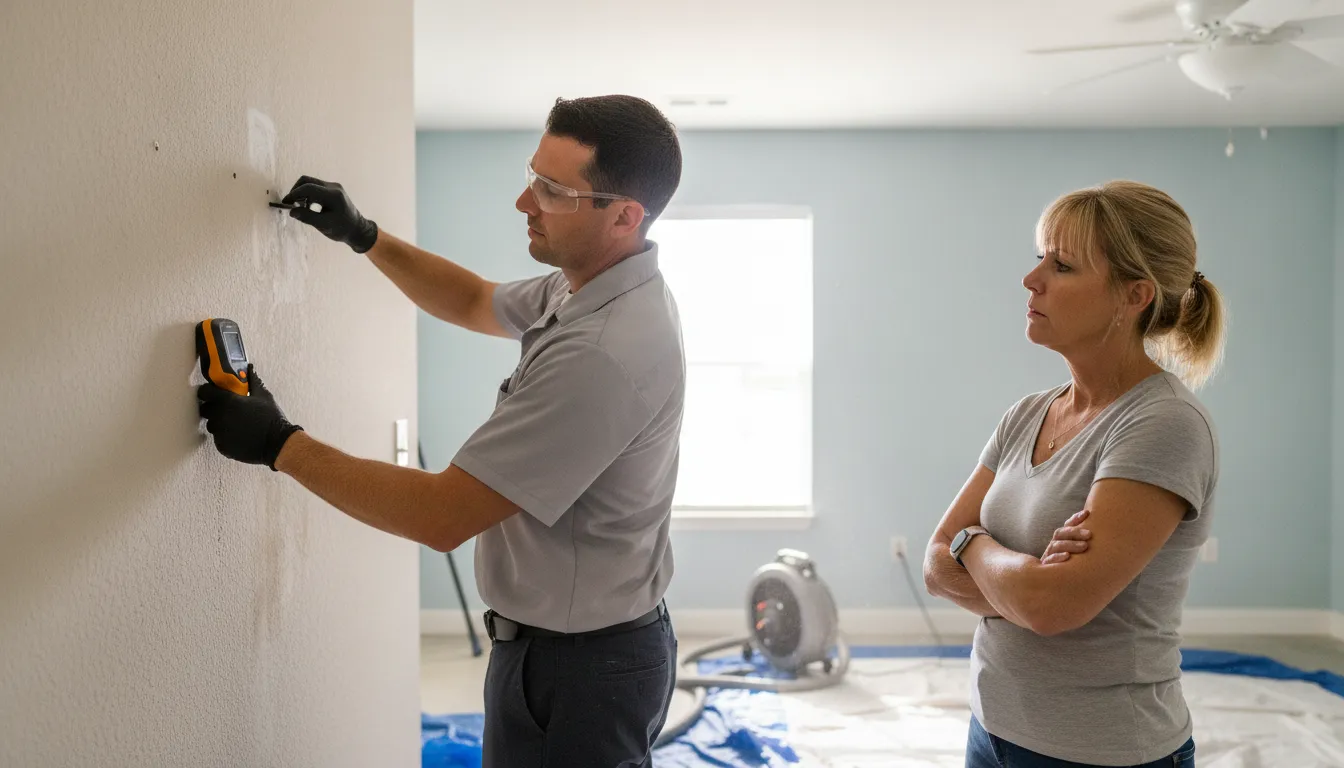
Ask how the company documents progress. Photos and moisture readings can show affected areas and track changes. Ask if you will receive copies. Find out which areas will be checked again. Ask how the results guide next steps. A structural drying and moisture check should be part of a clear process, not just equipment placed in a room.
Lingering moisture can contribute to mold growth. The EPA advises drying water-damaged areas and items within 24 to 48 hours. This general guidance does not mean every property will dry on the same schedule. Ask how the team will track conditions and respond if readings show more drying or investigation is needed.
If mold is a concern, ask how completion will be checked and who performs any testing. The EPA notes that there are no established safe mold levels or regulatory standards. Testing may have limited value, so clarify the question it is meant to answer. iMold uses independent third-party testing for unbiased verification. Ask how results are shared and what happens if a concern remains. Read about mold inspection and testing.
A dependable team should walk you through the documentation and explain readings in plain language. You do not need to interpret technical measurements yourself. You should be able to see what was checked, understand how the work is progressing, and know what verification will support closeout.
For help selecting a professional, the EPA recommends asking about qualifications, training, experience, and references.
Which Questions Should You Ask Before Work Begins?
- Who will perform the work, and who will supervise the project? Ask whether the people assessing the damage and completing each phase are part of the company’s team or another provider. Knowing who is responsible helps you direct questions and understand how the work will be coordinated.
- What evidence supports the assessment? Ask what the team inspected and whether photographs, moisture readings, or other records will document affected areas. Clear evidence gives you a useful reference for understanding the findings and discussing the proposed work.
- What work is included in the written scope, and what is not? Ask which areas and tasks are covered, what steps are planned, and whether reconstruction is included or handled separately. A clear scope helps prevent different expectations about what the project will accomplish.
- What role will you play in communicating with my insurance carrier? Ask what documents the company can provide, how it coordinates with the carrier, and which coverage questions you need to discuss with your insurer. This clarifies who handles each part of the process without assuming that a particular item will be covered.
- How will you keep me informed about progress? Ask who your contact will be, how updates will be shared, and when you can expect to hear about the next project stage. An agreed communication plan makes it easier to follow decisions and raise concerns promptly.
- What happens if you find additional damage after work starts? Ask how new findings will be documented, explained, and reflected in the scope or estimate before related work proceeds. Understanding the approval process helps you make informed decisions if the plan needs to change.
- How will we verify the work and review the project at closeout? Ask what records or checks will be provided for the work performed and any moisture or mold verification that applies. A clear closeout process helps you understand what was completed and what documentation you will receive.
| What to compare. | Useful evidence. |
|---|---|
| Credentials. | Applicable license details and relevant technician qualifications. |
| Work scope. | Written tasks, phases, and responsibility boundaries. |
| Moisture progress. | Documented readings, affected areas, and a verification plan. |
| Insurance support. | Clear records and an explanation of who decides coverage. |
| Communication. | A named contact, update method, and change-approval process. |
How Can You Compare Answers and Choose a Good Fit?
When speaking with more than one restoration company, compare how clearly each explains the next steps. A useful answer connects what the team observed to the work it proposes. If something is unknown, the company should say what needs further assessment. It should not present an assumption as a confirmed finding.
Listen for a clear scope. Ask what the team will handle and which stages may involve other professionals. Clarify where mitigation or remediation ends and reconstruction begins. These boundaries show who is responsible for each part and what decisions may come next.
Documentation and communication matter. Ask how findings, completed work, and progress will be recorded. Confirm who will keep you updated. The explanation should make sense, even when it includes technical terms. For insurance-related work, ask what records the company can provide and how it coordinates with the carrier. This coordination does not decide coverage.
For active water damage, timely assessment and practical next steps matter. Ask for a plain-language explanation of immediate work. Find out which decisions can wait. For a non-emergency concern, read the written scope before you agree to the work.
A good fit is a team that gives answers specific to your property. Its responsibilities should be clear, and its communication should work for you. You should understand what happens next, what the scope includes, and how you will hear about progress.

Schedule a no-cost visual mold inspection and estimate with iMold.
Frequently Asked Questions
How can I check a restoration company’s credentials?
Ask for the applicable state license and proof of insurance. Check the qualifications of those overseeing the work. iMold lists its restoration licenses and certifications. These include State Certified General Contractor (CGC1540205) and State Certified Mold Remediator (MRSR2170).
What should a written restoration estimate include?
Ask for the observed damage, areas and materials included, planned work, and estimated costs. Find out how new damage or changes will be handled. Review the scope before authorizing work. An estimate describes proposed work; it does not determine insurance coverage.
Can a restoration company coordinate with my insurance carrier?
Some providers share project records and communicate with carriers. iMold coordinates with carriers and uses Xactimate documentation. You should confirm coverage decisions with your insurer. Ask what records you will receive and read about restoration insurance claim coordination.
How can I confirm drying progress or independent mold testing?
Ask how the team measures moisture and records readings over time. For mold concerns, ask who performs testing and whether it is independent. iMold uses third-party testing for unbiased verification. Read about structural drying and moisture checks and mold inspection and testing.
Contact iMold for Restoration Help
Choosing a restoration company starts with clear questions. For an active emergency, contact iMold for 24/7 emergency restoration help. For a mold concern or to plan ahead, schedule a no-cost visual mold inspection and estimate.