

iMold provides 24/7 emergency service for property damage in Southwest Florida. If you are comparing a mold remediation company in Fort Myers, focus on how clearly each company explains the moisture source, the work plan, safety steps, and what happens after cleanup—not just on a fast estimate or a polished website.
Contact iMold about your property
Mold is often a sign that moisture has been present somewhere in a building. A useful conversation should therefore cover more than the visible spot. Ask what needs to be assessed, how affected areas will be protected, and how the company will explain the work before it begins. These seven questions can help homeowners and property managers compare proposals with care.
1. How will you identify the moisture source?
Cleaning or removing visible growth without addressing ongoing moisture may leave the underlying problem unresolved. Ask the company what it will inspect and how it will distinguish a current leak from older water damage or another moisture condition. The answer should explain the assessment process in plain language and identify any limits.
Depending on what is visible and accessible, an assessment may involve looking at nearby materials, checking for dampness, and considering plumbing, roof, window, or air-conditioning conditions. A company should not claim to know the source before evaluating the property. Ask what evidence supports its conclusion and whether another trade may need to repair a leak or building defect.
Also ask what areas the assessment will cover. A stain on one wall may call for checking adjacent materials or the other side of the wall, while the full building may not need the same level of investigation. The scope should fit the conditions rather than assume every room needs the same work.
2. What will be included in the written scope?
Before approving work, request a written description of the affected areas, planned tasks, and any items that are not included. Ask the company to distinguish assessment, containment, removal or cleaning, drying, and repairs if those steps apply. A clear scope helps you compare proposals that may use different wording or group tasks differently.
Look for specific descriptions rather than a broad line such as “treat mold.” The proposal should make it easier to understand which materials may be removed, what will be protected, and whether restoration or reconstruction is part of the proposed work. If something cannot be confirmed until materials are opened, ask how that possibility will be documented and discussed before additional work proceeds.
For a simple way to compare options, put the answers side by side:
| What to compare | Question to ask | What a useful answer clarifies |
|---|---|---|
| Moisture assessment | What areas and conditions will you check? | The assessment boundaries and any limitations |
| Work scope | Which materials and tasks are included? | What will be done, and what may require a separate scope |
| Protection | How will nearby areas and belongings be protected? | Planned containment and work-area precautions |
| Verification | How will completion be documented? | Records, observations, or testing options, if appropriate |
| Insurance | What documentation can you provide? | What the company can share for the property owner and carrier |
For a sense of the stages a restoration project may involve, review iMold’s restoration process and ask how the proposed tasks relate to your property’s conditions.
3. How will you protect the rest of the property?
Ask how the team will separate the work area from occupied or unaffected spaces, protect belongings, and manage materials during the project. The right precautions depend on the layout and the work being done. A responsible company should describe its approach for your specific situation rather than offer a one-size-fits-all promise.
Find out whether you need to move furniture, clear access to a wall or cabinet, or make arrangements for children, pets, employees, or customers. Ask what parts of the home or business may be unavailable while work is underway and how the team will communicate changes. These practical details can help you plan without assuming that every project requires the same setup.
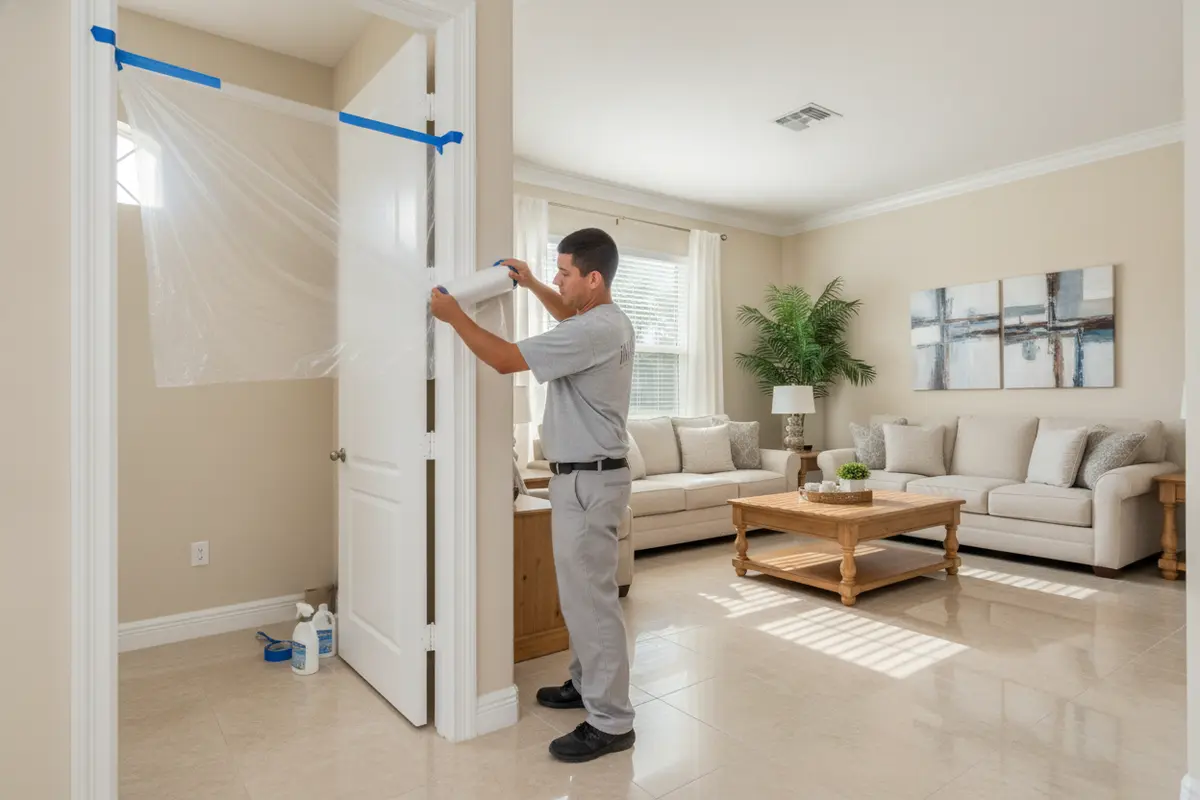
The company should also explain how it will handle dust and debris and what you should avoid touching or moving. If you have questions about the proposed precautions, ask for an explanation before work starts. Clear communication is an important part of a workable plan.
4. Who will perform the work, and what qualifications can you verify?
Ask who will oversee the project, who will be on site, and what credentials or licenses apply to the work being proposed. Then verify the wording and status through the relevant state or credentialing resources. Do not assume that a company’s marketing phrase answers every question about the people or tasks involved.
Ask whether the company is licensed, bonded, and insured, and whether it can explain which credentials apply to mold remediation and any related repair work. For iMold, the public-facing state credential wording is State Certified Mold Remediator (MRSR2170) and State Certified General Contractor (CGC1540205). The company also describes its work as IICRC certified. Ask any company you are considering to identify applicable credentials and provide details you can verify.
It is reasonable to ask who your point of contact will be and how you will receive updates. You should not need to guess who is responsible for answering questions about the scope, schedule, or changes. Review the company’s background and company information, then ask direct questions about the team assigned to your project.
5. What inspection, testing, or completion checks do you recommend?
Ask what observations or tests are appropriate for the conditions at your property and what each one can—and cannot—tell you. Testing may be useful in some circumstances, but it should not be presented as an automatic substitute for understanding the moisture issue and the proposed work. Ask who performs any testing, what the results will show, and how they will be explained.
iMold uses third-party mold testing for unbiased verification when testing is part of the project. Ask whether an independent test is recommended in your case, when it would occur, and how results fit into the plan. You can also ask what documentation you should expect at the end, such as a record of completed work or test results where applicable.
Be cautious of absolute promises made before anyone has assessed the property. A sound answer sets expectations, explains the basis for recommendations, and makes room for findings that may change once hidden materials are accessible.
6. How will you handle insurance documentation and communication?
Insurance coverage depends on the policy and the circumstances of the damage, so a restoration company should not promise that a carrier will pay for specific work. Ask what records the company can provide, how it documents affected areas and work performed, and whether it can coordinate information with your insurer when appropriate.
Before making decisions, review your policy and speak with your insurance representative about your coverage, notice requirements, and claim process. Keep copies of photos, estimates, reports, and messages. Ask the contractor to explain its own scope and documentation separately from coverage decisions. This makes it easier to understand what the company proposes without treating an estimate as a guarantee of insurance payment.
iMold works with insurance carriers and uses Xactimate for claims documentation. You can read more about insurance claims and mold remediation, and ask what information may be available for your specific project. A company should be willing to explain what it can do and what remains between you and the insurer.
7. What does follow-up look like after the work?
Ask what the company considers completion, what records you will receive, and whom to contact if you have a question after the crew leaves. If there are repairs or reconstruction tasks, confirm whether they are included in the proposal, handled separately, or outside the company’s scope. Put the answer in writing so there is less room for misunderstanding.
Also ask what conditions you should monitor, especially if a moisture source needs repair by another professional. A remediation company cannot make an unresolved leak disappear through cleanup alone. Knowing which follow-up steps belong to you, the restoration contractor, or another trade helps keep the plan organized.
Full-spectrum restoration may connect emergency response, mitigation, and reconstruction, but the work included still depends on the written scope. iMold describes services from emergency restoration response through restoration work; ask which parts are relevant to your property rather than assuming every service is included.
How can you compare companies without focusing only on price?
Price matters, but comparing a single total can hide differences in the areas assessed, materials included, protection plan, documentation, or follow-up. Ask each company to explain its scope in the same categories. If estimates differ, request clarification about the difference rather than assuming the higher or lower number represents the same work.
You can also review public business information and customer feedback as one part of your research. The Better Business Bureau’s mold-removal directory for Fresno illustrates the kinds of business profiles, ratings, and customer reviews a directory may display; it is not a Fort Myers recommendation. For a local decision, check the company’s current service area, credentials, written scope, and references or reviews relevant to the work you need.
iMold has operated in Southwest Florida for 28 years and reports more than 900 Google reviews with a 4.9-star average. These are useful context, not a substitute for asking what your own project includes. You can browse iMold customer reviews and its mold remediation services, then compare the actual written plan with other proposals.
For a Fort Myers property, you can also confirm that the company serves the area through its Fort Myers service-area information. A local company should be able to explain its service territory and how it handles a project in your neighborhood without making unsupported timing guarantees.

What should you prepare before speaking with a company?
A few notes can make the first discussion more useful. Write down when you first noticed the condition, whether it has changed, and what was happening around that time. If you know about a leak, roof issue, plumbing repair, appliance overflow, or air-conditioning concern, mention it. If you do not know the cause, say so rather than guessing.
Photographs may help document visible conditions and changes over time. Take them only when you can do so safely, and avoid disturbing materials or entering an area that feels unsafe. Keep copies of relevant repair records, insurer correspondence, and any previous assessment or testing documents. Share these details with the company, but ask it to verify conditions during its own assessment.
Make a list of practical concerns, too: rooms that must remain accessible, business hours, household needs, sensitive belongings, or questions about who will move and protect items. Tell the company about any relevant access constraints before it prepares a scope. Do not assume that the estimate includes packing, storage, or moving belongings unless those tasks are stated.
During the discussion, take notes on what the company says is confirmed, what remains uncertain, and what information it needs next. Before approving work, read the written scope and ask about unfamiliar terms. If a recommendation changes after further assessment, ask for an updated explanation and documentation before you decide how to proceed. A careful exchange at the start can help set realistic expectations for everyone involved.
Frequently Asked Questions
Should I get more than one mold remediation estimate?
When practical, comparing more than one written estimate can help you understand proposed tasks and identify missing details. Compare the scope, assessment, protections, documentation, and follow-up—not only the total. Ask each company to explain any major differences.
Does a mold inspection automatically include remediation?
Not necessarily. An inspection or assessment describes conditions and recommendations; remediation is work performed under an agreed scope. Ask whether the company’s estimate includes the assessment, the proposed remediation, testing, repairs, or only some of those steps.
Can a restoration company guarantee insurance will cover the work?
No company should promise a coverage decision made by your insurer. Ask what documentation the contractor can provide, review your policy, and discuss coverage and claim requirements with your insurance representative.
Get clear answers about your property
If you are comparing options, write down your questions and request a scope you can understand before authorizing work. iMold offers no-cost visual mold inspections and estimates; contact the team to discuss your property and the next appropriate step.
Request a no-cost visual inspection or estimate
A clear plan should explain what is known, what work is proposed, and how questions will be handled as the project moves forward.

