

When water enters a Fort Myers property, the first question is often cost. What will it take to dry the building and protect the contents? Acting promptly limits secondary damage. Waiting can let moisture reach flooring, drywall, cabinets, and hidden spaces.
nn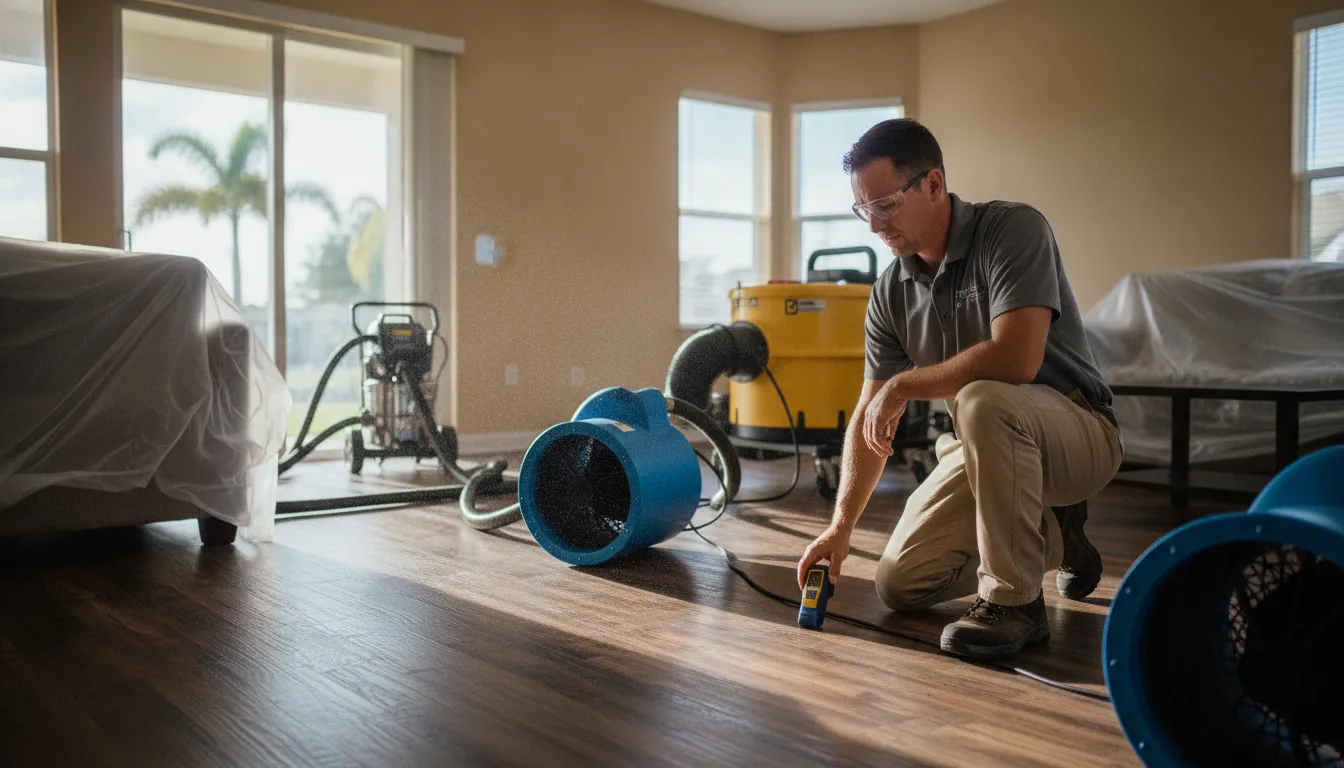
Typical water damage restoration cost Fort Myers projects can span from the low thousands to $30,000 or more. It depends on the water category, the affected area, and how long moisture remains. These are market-context estimates, not an iMold quote. A no-cost visual inspection is the reliable way to understand your propertyu2019s needs.
nSchedule a free water damage inspection and estimate with iMold today.
niMold Cleaning and Restoration is available 24/7, with a 30-minute response promise in its immediate service zone. The team can coordinate with your insurance carrier. For an overview of the water damage restoration process, start here, then consider the conditions that most directly shape the final scope and cost.
nWhat Factors Determine Water Damage Restoration Costs?
nRestoration providers commonly quote a broad market range for Fort Myers, from roughly $1,500 for limited damage to $35,000 for major losses, according to local market guidance from Wrightway. Those figures are estimates, not an iMold price list or a guaranteed quote. The final scope depends on what happened, how far the water traveled, and what is required to return the property to a safe, dry condition.
nWater category affects the work involved. The source of the water is one of the first cost factors. Category 1 is clean water, such as a broken supply line. Category 2, or gray water, contains significant contamination. Category 3, or black water, is grossly unsanitary and requires more protective measures, controlled removal, and specialized cleaning. The EPA describes these water categories by their source and contamination level. A supply-line leak is handled differently from sewage, floodwater, or water that has contacted contaminated materials.
nThe size and location of the affected area matter. A small, contained leak may require less extraction, drying equipment, and material removal than water that has spread through several rooms. Water can also move beneath flooring, into wall cavities, under cabinets, or through ceilings. Restoration may involve moisture mapping, extraction, air movers, dehumidification, controlled demolition, and reconstruction. A leak from a burst pipe, appliance, flood, or storm can each create a different pattern of damage.
nMaterials respond differently to moisture. Porous materials such as drywall, insulation, carpet padding, and some wood products can absorb and retain water. Depending on contamination and drying conditions, they may need removal rather than surface cleaning. Tile, concrete, and other less-porous surfaces may be restorable, but moisture can still collect beneath or behind them. The material type, amount, and accessibility all influence labor, equipment, disposal, and repair needs.
nTime increases the risk of secondary damage. The longer moisture remains, the harder it may be to dry materials and the more likely hidden damage becomes. Mold can begin growing within 24 to 48 hours when moisture remains present, and early moisture remediation is emphasized in established guidance. Southwest Floridau2019s naturally high humidity can accelerate mold growth. Structural decay or mold behind walls may not be visible during the first inspection, which is why a complete assessment matters. Acting promptly can reduce the scope of remediation and long-term reconstruction costs.
nA professional inspection can identify visible and hidden moisture before the repair plan is set. iMold offers a no-cost visual inspection and estimate, allowing the property owner to understand the specific scope instead of relying on a generic range.
nAverage Water Damage Restoration Costs in Southwest Florida
nHomeowners searching for the average water damage restoration cost in Fort Myers will see a wide range because restoration projects are not identical. Local restoration providers commonly cite industry estimates from roughly $1,200 for a minor. One-room cleanup to more than $35,000 for extensive damage involving multiple rooms, structural materials, or reconstruction. These figures are market context only. They are not guaranteed iMold prices or a substitute for an inspection.
nOne Southwest Florida estimate places many projects in the $2,500 to $7,500 range across Naples, Bonita Springs, Marco Island, and nearby communities. Its examples describe minor one-room leaks at about $1,200 to $2,500. Moderate intrusion affecting two or three rooms at approximately $2,500 to $5,000, and major flood or storm damage at $5,000 to $10,000 or more. Another commonly cited Fort Myers breakdown places minor projects at $1,500 to $5,000, moderate projects at $5,000 to $15,000, and major projects at $15,000 to $35,000.
nHow to interpret typical cost ranges
nThe difference between these ranges does not mean one provider can predict your final total from a phone call. The scope may include emergency water extraction, drying equipment, monitoring, removal of unsalvageable materials, cleaning, antimicrobial treatment, repairs, or reconstruction. The source and category of the water also matter. A clean-water supply line leak may require a different response than contaminated water from a sewage backup or storm event.
nCosts can also rise when moisture remains hidden inside walls, under flooring, or below cabinets. The longer water sits, the greater the risk of secondary damage and more extensive reconstruction. Acting promptly can help limit the amount of material that must be removed and reduce avoidable repair costs. It is a practical reason to call early, even when the visible area appears small.
nThe only way to know your project cost
nAn exact number requires a free, on-site visual inspection and estimate. A qualified technician can identify the water source, assess the affected areas, check for concealed moisture, document the condition. And explain which work is needed now versus what may require later repair. iMold also coordinates with insurance carriers and can prepare documentation using standard estimating practices when a covered loss is involved.
nAsk for a written, project-specific scope rather than relying on a national average. That approach gives you a clearer understanding of the immediate mitigation work, possible repair needs, and available payment or insurance options. If water is still spreading or materials remain wet, prioritize stopping the source and beginning assessment. Early action protects the property and gives the restoration team the best chance to control the scope.
nCategory 1 vs Category 2 vs Category 3 Water Damage: What It Means for Your Cost
nThe category assigned to water damage helps determine the safety controls, equipment, disposal requirements, and restoration steps a property may need. The U.S. Environmental Protection Agency describes Category 1 as clean water from a sanitary source, such as a broken supply line. Category 2, or gray water, contains significant contamination. Category 3, or black water, is grossly unsanitary and may contain pathogens. Read the EPAu2019s water-category definitions.
nThese categories are not fixed price tags. The final water damage restoration cost fort myers property owners face also depends on the affected area, building materials, how long moisture remained, and whether reconstruction is needed. Still, moving from Category 1 to Category 3 generally increases complexity, safety requirements, and cost because the work requires more controls and may involve more extensive removal.
n| Category | nSource & Water Type | nTypical Scenarios | nRelative Cost Impact | n
|---|---|---|---|
| Category 1 | nClean water from a sanitary supply source. | nBroken water supply line or an overflow from a clean-water fixture. | nOften the lowest relative impact when found quickly, though drying time still matters. | n
| Category 2 | nGray water with significant contamination. | nWater from certain appliances or contaminated fixtures. | nHigher than Category 1 because cleaning and protective measures become more involved. | n
| Category 3 | nBlack water that is grossly unsanitary. | nSewage, flooding, or other water that may carry dangerous contaminants. | nTypically the highest impact because of safety controls and specialized handling. | n
A Category 1 leak can still become more expensive if it spreads beneath flooring, enters wall cavities, or remains undiscovered. Conversely, a prompt response may limit the area requiring removal and drying. In Southwest Florida, acting quickly is especially practical because warm, humid conditions can support faster mold development. Mold can begin forming within 24 to 48 hours when moisture remains present, according to the iMold research record. While early moisture remediation protocols emphasize the first 48 hours as an important prevention window. Review the National Academiesu2019 discussion of indoor moisture and microbial growth.
nAfter water removal and structural drying, the property should be inspected regularly for mold, particularly after flooding or prolonged moisture exposure. That recommendation is consistent with CDC guidance on inspecting buildings after water and wind damage. A professional inspection can identify the category, document affected materials, and explain which work is mitigation versus reconstruction. iMold offers a no-cost visual inspection and estimate. So Fort Myers property owners can understand the scope before deciding on next steps.
nHow Much Does Water Damage Restoration Cost in Fort Myers?
nWhen researching water damage restoration cost Fort Myers property owners will see a wide range rather than one standard price. Restoration providers commonly cite market estimates from about $1,500 for limited damage to $35,000 or more for extensive loss. Some Southwest Florida estimates place average projects around $2,500 to $7,500, with larger losses reaching $10,000 or more. These figures are general market context, not guaranteed iMold prices or a quote for your property.
nFort Myers has local conditions that can affect the scope of a water-loss project. Tropical storms and hurricanes can introduce water through roofs, windows, exterior openings, and flooded areas. Southwest Floridau2019s naturally high humidity also makes it harder for wet materials to dry on their own and can accelerate mold growth when moisture remains. The source and category of water, the rooms affected, the materials involved, and how long the property stayed wet all matter. A small, quickly contained leak is a different restoration project from storm-related water that has moved into flooring, drywall, insulation, or structural components.
nTiming is one of the most practical ways to limit the eventual reconstruction scope. Early identification of moisture problems can save thousands in reconstruction costs by allowing technicians to extract water, establish drying conditions, and address affected materials before damage spreads. In a humid Fort Myers environment, waiting for visible damage to worsen is not a reliable way to control expenses. It can also turn a straightforward drying project into a broader restoration effort.
n- n
- Limited damage: A contained leak affecting a small area may require extraction, targeted drying, and limited material repair. n
- Broader water intrusion: Water that travels through multiple rooms or building materials may require more equipment, demolition, drying verification, and reconstruction. n
- Storm or contaminated water: Flooding and other contaminated sources require additional safety controls and specialized remediation procedures. n
iMold brings 28 years of experience serving Fort Myers and the surrounding Southwest Florida region. That local experience helps the team account for storm exposure, humidity, building conditions, and the difference between visible water and moisture hidden behind materials. The exact figure for a specific property can only come from a professional assessment, not an online average. iMold provides a free visual inspection and estimate so you can understand the damage, recommended scope, and expected restoration plan without committing to a generic number.
nDoes Homeowners Insurance Cover Water Damage Restoration?
nOften, yes, but the answer depends on your policy, the source of the water, and what caused the damage. Homeowners insurance commonly covers sudden and accidental incidents, such as a burst supply pipe or an appliance that unexpectedly leaks. It may not cover gradual damage from a long-term leak, deferred maintenance, or flooding from outside the home. Flood damage may require separate flood insurance, so review your policy and contact your carrier before assuming a claim will be approved.
nDoes homeowners insurance cover water mitigation? In many sudden-loss situations, mitigation is covered because prompt extraction and drying can limit additional damage. Coverage decisions still belong to your insurance company. A restoration professional can help you understand the documentation needed, but cannot guarantee coverage or replace your adjusteru2019s determination.
nDocument the damage before and during restoration
nGood records help your carrier evaluate what happened, what was affected, and which work was necessary. When it is safe to do so, take photos and videos before moving damaged contents or removing materials. Save receipts for emergency services, keep a timeline of when you discovered the water, and record conversations with your carrier. Do not delay essential mitigation while waiting for an adjuster if ongoing moisture could cause more damage. Instead, ask your carrier about its preferred procedures and keep the restoration company informed.
n- n
- Photograph visible water, affected rooms, contents, and apparent source conditions. n
- Keep written notes about discovery, calls, inspections, extraction, drying, and repairs. n
- Request moisture readings, equipment records, work authorizations, and photo evidence from the restoration team. n
- Confirm whether damaged materials should be saved for inspection before disposal. n
Choose a restoration partner that can coordinate with your carrier
niMold works directly with insurance carriers and uses Xactimate for transparent, industry-standard billing. The team documents the restoration process, including photo evidence, to support the claim. iMold is also often a preferred vendor for insurers. Which may streamline communication when your carrier directs you to an approved provider. You can read more about insurance coverage for water damage before calling.
nContact your carrier early, then choose a qualified restoration professional who can assess the source. Begin appropriate mitigation, and maintain a clear record from inspection through drying and repairs. A no-cost visual inspection and estimate can help you understand the work needed while your coverage is being reviewed.
nHow to Get a Free Water Damage Estimate from iMold
nA clear estimate begins with a timely, professional assessment. iMold makes that first step straightforward. With no-cost visual inspections and estimates for water damage properties in Fort Myers and throughout Southwest Florida. Follow these steps to understand what is happening, what work may be needed, and how payment or insurance coordination can be handled.
n- n
- Call the 24/7 emergency line. Contact iMold at 877-771-1699, day or night. In the immediate service zone, the team targets a 30-minute response. Sharing when the water started, where it is visible, and whether the source is still active helps the team prepare. Prompt action matters because early identification can reduce the scope of remediation and long-term reconstruction costs. n
- Request a free visual inspection and estimate. Ask for the no-cost inspection and estimate specifically. There is no obligation to authorize work simply because a technician visits the property. The purpose is to give you a clearer picture of the affected areas and the practical next steps, without requiring you to make an immediate financial commitment. n
- Let an IICRC-certified technician assess the damage. A trained technician evaluates the water category, affected area, materials involved, and drying scope. This assessment may include looking beyond visible surface damage, since moisture can affect building materials in less obvious locations. If mold concerns require verification, iMold can use unbiased third-party testing to provide transparent results. The restoration plan follows the iMold Way: Assess, Contain, Extract, Remediate, Restore. n
- Review the custom quote and payment options. After the assessment, you receive a custom scope and quote based on the propertyu2019s documented needs. Rather than a generic price. iMold works directly with insurance carriers and uses Xactimate for industry-standard documentation and billing support. Financing options, including programs with 0% interest, may also be available. iMold is licensed, bonded, and insured, and holds Florida General Contractor license CGC1540205. n
A free estimate is the practical way to replace guesswork with a documented plan. It can also help you decide how quickly to begin mitigation, whether you are paying directly or coordinating with your insurer.
nSchedule a free water damage inspection and estimate with iMold.
nFrequently Asked Questions
nWhat is the average cost of water damage restoration in Fort Myers?
nLocal market estimates commonly range from $1,500 to $35,000, depending on the affected area, water category, moisture duration, and reconstruction needs. These are broad industry estimates, not an iMold quote. A no-cost visual inspection is the reliable way to identify the actual scope and prepare a custom estimate. See the published Fort Myers cost range.
nWhat factors influence water damage restoration costs?
nThe main factors are the size of the affected area, whether the water is clean or contaminated. How long materials stayed wet, and whether flooring, drywall, cabinets, or other elements require repair. Prompt extraction can limit secondary damage and help keep the project focused on necessary restoration rather than expanded reconstruction.
nWill homeowners insurance cover water damage restoration?
nCoverage depends on your policy and the source of the water. Sudden, accidental damage may be treated differently from long-term maintenance issues or excluded causes. iMold can document conditions. Coordinate directly with carriers, and use Xactimate to support the claim. Review your policy and contact your insurer for coverage decisions.
nHow long does the restoration process take?
nMinor projects may take a few days, while extensive damage can require several weeks when drying, demolition, repairs, and reconstruction are involved. The timeline becomes clearer after moisture assessment and depends on what materials are affected. Local restoration guidance outlines the typical timeline range.
nIs emergency water damage restoration available 24/7 in Fort Myers?
nYes. iMold provides 24/7 emergency response and aims for a 30-minute response in its immediate service zone. Calling promptly allows a technician to assess the source, begin containment and extraction when appropriate, and explain the next steps before damage spreads.
nSchedule Your Free Water Damage Inspection
nA clear inspection can help you understand the work your Fort Myers property may need and the next steps for restoration. iMold can review the damage. Explain your options, and provide a no-cost estimate.
nCall iMold today at 877-771-1699 for a free water damage inspection and estimate.
nttttttnttttttnttttntntttttt nttttttt
