iMold Cleaning and Restoration provides 24/7 emergency service for Southwest Florida property damage, along with professional air duct cleaning for homes and businesses in Fort Myers. If dust, odors, moisture, or a recent restoration project has you questioning your HVAC system, this guide explains when cleaning makes sense, what the visit includes, and how a transparent custom quote is built.
Schedule air duct cleaning in Fort Myers with iMold and request your free estimate.
Quick answer: Air duct cleaning is usually a condition-based service, not an automatic yearly requirement. It may be appropriate when an inspection finds substantial dust or debris, visible mold on suitable HVAC components, pests, odors, or contamination after water, fire, smoke, or construction. The final cost depends on the system, access, contamination, and work required.
Why Can Florida’s Climate Affect Air Duct Decisions?
Fort Myers homes rely on air conditioning for much of the year. That means HVAC components repeatedly move cooled air across a warm, humid environment. Humidity alone does not prove that ducts need cleaning, but moisture, dust, construction debris, leaks, or an unresolved water problem can change the decision. An inspection should distinguish normal household dust from a condition that warrants professional work.
The U.S. Environmental Protection Agency (EPA) does not recommend routine duct cleaning as a universal yearly maintenance step. Its guidance says homeowners should consider cleaning when there is substantial visible mold on appropriate HVAC components, vermin, heavy deposits of dust or debris, or material being released into living areas. The cause should also be corrected, or contamination can return. Read the EPA’s air duct cleaning guidance before making a decision.
When Is Air Duct Cleaning Necessary in Fort Myers?
Air duct cleaning is worth investigating when there is a documented contamination or performance concern, rather than simply because a certain number of years has passed. In Fort Myers, the most useful starting point is a visual and system assessment that identifies the source, shows the affected components, and separates cleaning from repair or mold remediation.
- Visible debris is being released: Dust or other particles come from supply registers when the system runs, or deposits are substantial inside accessible components.
- There is a persistent odor: Musty, smoke, pet, or other unusual odors appear to originate at the HVAC system and remain after ordinary filter changes and housekeeping.
- Water, fire, or smoke affected the system: A restoration event introduced moisture, soot, ash, or debris into ducts, the air handler, or connected components.
- There is visible mold on an appropriate surface: A qualified professional documents suspected growth rather than treating a dark spot or dust as proof. Porous or wet duct materials may require replacement, not cleaning.
- Pests or vermin entered the system: Droppings, nesting material, or insects require source control and careful cleanup.
- Renovation debris entered the HVAC system: Drywall dust, sawdust, or other construction particles can accumulate when registers or equipment were not protected.
- Airflow concerns need diagnosis: Uneven rooms, unusual register noise, or a sudden change in performance may point to a leak, crushed duct, blocked filter, equipment problem, or contamination. Cleaning is not a substitute for HVAC repair.
The National Air Duct Cleaners Association (NADCA) standard identifies contamination, unacceptable odors, visible discharge, fire or water damage, pests, construction debris, and certain microbial conditions as reasons to assess HVAC cleaning. Its ACR standard for HVAC assessment, cleaning, and restoration also emphasizes access, source control, and cleanliness verification.
How Often Should Fort Myers Homeowners Clean Their Air Ducts?
There is no universal Fort Myers schedule that applies to every home. EPA guidance treats duct cleaning as an as-needed decision, while filter changes, drain-pan care, coil maintenance, and professional HVAC inspections remain routine maintenance. Consider a new assessment after renovation, a flood or smoke event, a pest problem, visible debris, persistent odor, or a change in indoor conditions. Ask for evidence before approving recurring work.
Pets, construction activity, occupancy, filter practices, moisture control, and the condition of the HVAC system all affect how quickly contamination can accumulate. A clean filter helps limit new debris, but it cannot correct a leak, wet insulation, mold source, or contaminated blower compartment. If the same odor or dust returns quickly, the source matters more than repeating a surface cleaning.

What Does Professional Air Duct Cleaning Include?
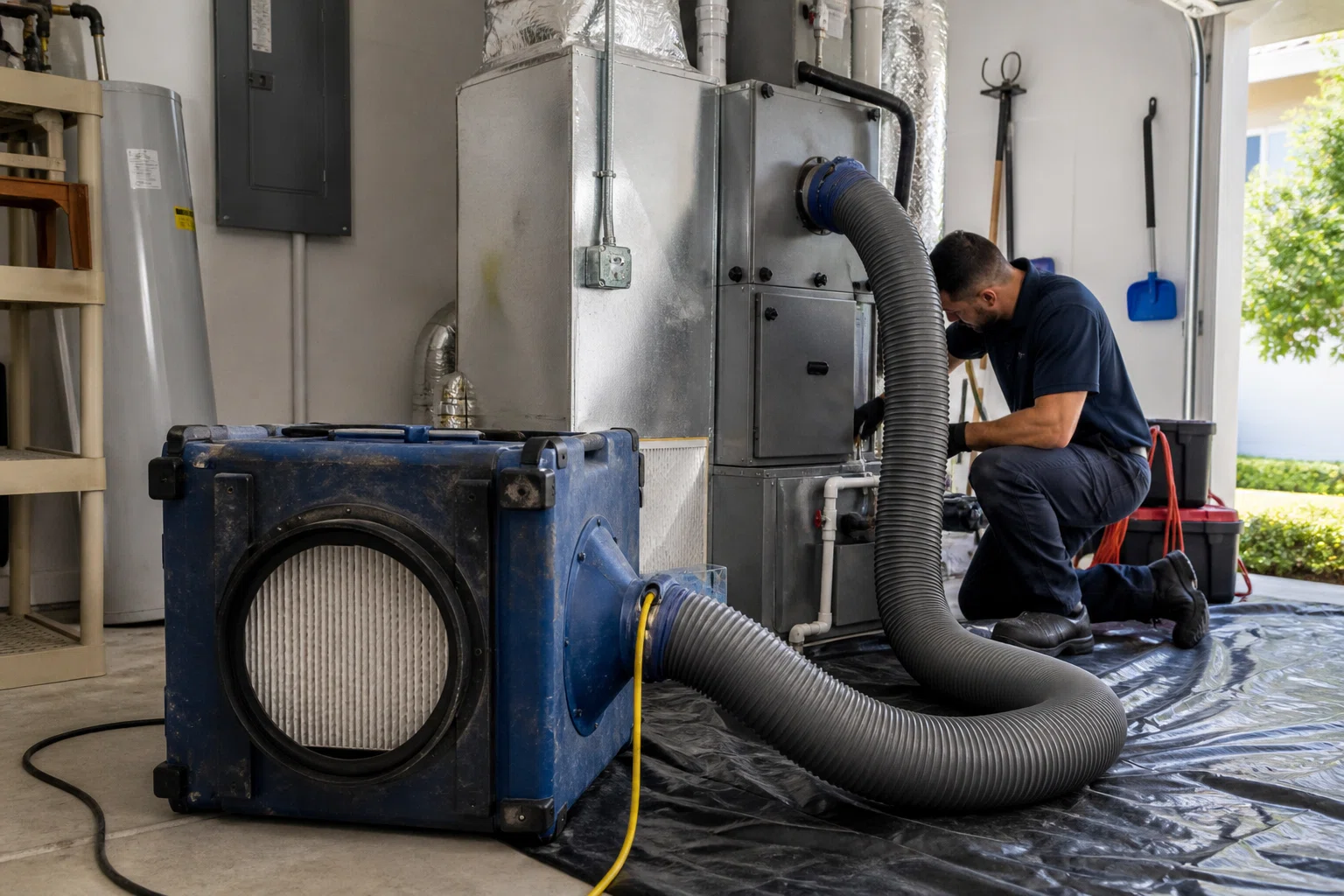
A professional visit should begin with an inspection and a defined scope, followed by protection of the home and controlled collection of debris. NADCA’s framework calls for appropriate access, mechanical cleaning methods, capture of removed material, and verification. The exact sequence varies by system design and condition, but a complete visit commonly includes:
- Assessment and documentation: The technician reviews symptoms, filters, accessible ductwork, vents, air handler components, moisture indicators, and any recent water, fire, smoke, or construction event.
- Home protection: Floors, furnishings, and work areas are protected. Access points are handled carefully so loosened material does not spread through the occupied space.
- Controlled agitation and HEPA collection: Appropriate brushes or air tools loosen non-adhered material while a suitable vacuum collection system captures it.
- Component cleaning: When included in the approved scope, technicians may clean registers, grilles, the blower compartment, coils, plenums, and other accessible components. This is different from simply vacuuming vent covers.
- Source correction: A leak, moisture source, pest entry, mold condition, or damaged porous liner must be addressed separately when cleaning alone cannot solve the problem.
- Reassembly and verification: The system is reassembled, openings are secured, the homeowner’s new filter is installed when appropriate, and airflow or operating performance is checked.
Ask the provider which components are included, how removed material will be contained, whether any treatment is optional, and how suspected mold will be confirmed. No provider should promise that duct cleaning alone cures allergies, prevents illness, or solves every energy concern.
Talk with iMold about a documented air duct cleaning plan for your Fort Myers property.
How Much Does Air Duct Cleaning Cost in Fort Myers?
Air duct cleaning in Fort Myers is normally priced by inspected scope rather than a universal flat amount. iMold provides a free estimate and a custom quote after reviewing the property and system. A trustworthy quote should explain what is included, what is optional, and whether a separate repair or remediation service is recommended.
| Quote factor | Why it matters |
|---|---|
| System size and layout | More supply runs, return paths, air handlers, or difficult access points can require more labor and setup. |
| Contamination type | Loose dust, construction debris, smoke residue, pests, moisture, and suspected mold do not receive the same treatment. |
| Component scope | A quote should identify whether registers, grilles, blower parts, coils, plenums, and other accessible components are included. |
| Access and protection | Attic, crawl-space, high-ceiling, or restricted access can change equipment, containment, and labor needs. |
| Related repairs or remediation | Leaks, wet insulation, damaged duct materials, mold, or equipment issues may need a separate solution before or after cleaning. |
| Property type and scheduling | Residential, commercial, condominium, and occupied properties can require different coordination and protection plans. |
Be cautious of a quote that is too vague to identify the work or one that uses an alarming claim to pressure you. Ask for before-and-after documentation where accessible, the planned equipment, the full component list, and the conditions that would change the scope. iMold can also coordinate with insurance professionals when duct contamination is part of a covered water, fire, or smoke loss, using documented findings and Xactimate estimating where appropriate.
Should You Choose Cleaning, HVAC Repair, or Mold Remediation?
The right service depends on the source of the problem. Cleaning removes appropriate accumulated material. HVAC repair addresses leaks, crushed or disconnected ducts, equipment faults, and airflow design problems. Mold remediation addresses confirmed or professionally assessed microbial contamination and the moisture condition that allowed it to develop. These services can overlap after a water or smoke event, but they should not be sold as interchangeable.
- Choose an HVAC evaluation: when rooms are uneven, ducts whistle, airflow has changed, or equipment is not performing normally.
- Choose air duct cleaning: when inspection supports removal of dust, debris, odors, or contamination from cleanable components.
- Choose mold or water damage assessment: when there is active moisture, visible suspected growth, wet porous material, or a recent property damage event.
For a broader view of connected services, see iMold’s specialty mold and restoration services in Florida. The guide explains how cleaning, mold remediation, water mitigation, and reconstruction can fit together when one problem creates several restoration needs.
Why Work With iMold for Air Duct Cleaning in Fort Myers?
iMold Cleaning and Restoration has served Southwest Florida for 28 years with a full-service approach that extends beyond a quick vent vacuum. The company is licensed, bonded, and insured, with more than 35 certified professionals, seven IICRC credentials, and experience connecting specialty cleaning to water damage, mold remediation, and rebuild work.
That broader capability matters when duct concerns follow a leak, storm, smoke event, renovation, or suspected mold condition. iMold can document findings, explain whether cleaning is appropriate, coordinate with insurance carriers when relevant, and recommend the next step without promising that one service solves every cause. The company also maintains more than 900 Google reviews with a 4.9-star average rating.
For routine specialty cleaning, visit iMold’s specialty cleaning services page. For property damage emergencies, iMold is available 24/7, with a 30-minute response promise for the immediate service zone. That emergency response language applies to urgent damage dispatch, not a guaranteed appointment time for every scheduled duct-cleaning visit.
Frequently Asked Questions
Is air duct cleaning necessary every year?
No. The EPA does not recommend routine annual duct cleaning for every home. Cleaning should be considered when inspection finds substantial contamination, visible mold on appropriate components, pests, unusual odors, debris discharge, or damage-related contamination.
Does air duct cleaning remove mold?
Cleaning may remove contamination from suitable cleanable components, but it is not a complete mold-remediation plan. The moisture source must be corrected, affected materials must be evaluated, and porous or damaged materials may need replacement. Ask the provider to document suspected mold and explain the recommended scope.
Will air duct cleaning lower my energy bills?
Not automatically. Cleaning a contaminated component may help restore function, but energy performance also depends on duct leaks, insulation, equipment condition, filters, and controls. An HVAC evaluation may be more appropriate when the main symptom is uneven temperature or rising utility use.
How can I compare air duct cleaning quotes?
Compare the inspection findings, component list, access plan, protection methods, collection equipment, optional treatments, documentation, and any separate repairs. A low headline price is not meaningful if the provider does not state what the quote covers.
Does iMold offer air duct cleaning near Fort Myers?
Yes. iMold serves Fort Myers and nearby Southwest Florida communities. Contact the team for a free estimate and explain whether the request is routine cleaning, post-renovation cleanup, or connected to water, fire, smoke, odor, or suspected mold damage.
Contact iMold at 877-771-1699 to schedule Fort Myers air duct cleaning.